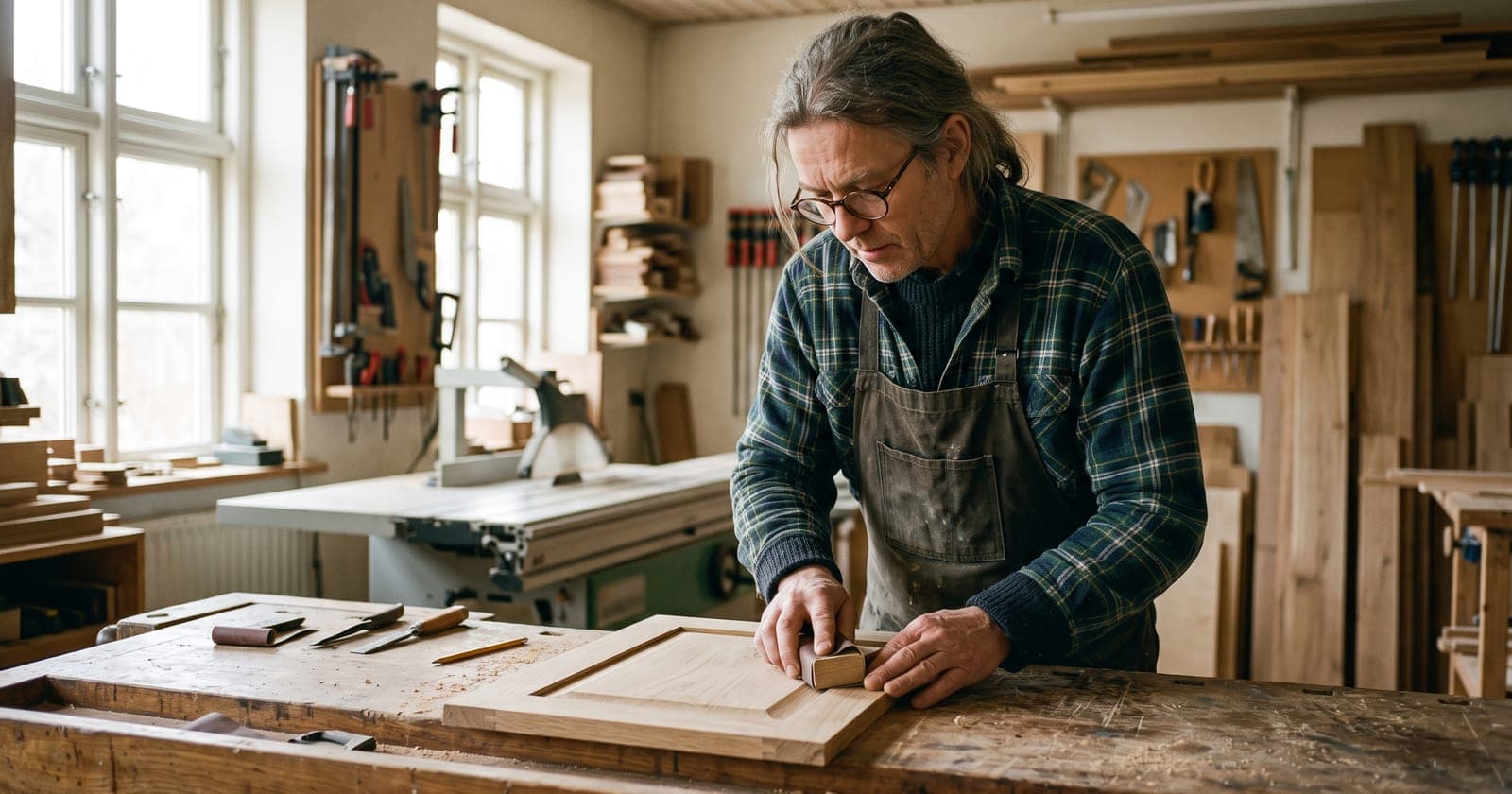
How carpenters can quote custom joinery jobs faster with AI
How carpenters can quote custom joinery jobs faster with AI
AI helps carpenters quote custom joinery faster by turning a site visit's photos, rough sketches and a client brief into a structured materials list, labour estimate and draft quote document in minutes rather than hours. It doesn't replace your judgement on fit, finish or timber selection - but it removes the repetitive drafting work so you can spend your evening on the detail that actually wins the job. Used well, it typically cuts the admin side of quoting bespoke work by a significant margin, while the pricing decisions stay with you.
Why custom joinery is harder to quote than most trades
A kitchen fitter working from a standard carcass range can price a job from a catalogue. A carpenter building a bespoke staircase, a fitted alcove unit, or a one-off oak door has no catalogue to lean on. Every job has its own joints, its own timber movement allowances, its own hardware spec, and often its own site quirks - a wall that's out of square, a stairwell that was never quite plumb, a client who wants "something like that photo but wider."
That variability is exactly why joinery quotes take longer to write than almost any other trade. You're not filling in a template; you're designing the job on paper before you've built it in the workshop. AI won't design the piece for you, but it can handle the parts of the process that are genuinely repetitive: converting rough dimensions into a cutting list, drafting the written scope, and assembling the quote document around your pricing.
Turning a site visit into a structured brief
Most custom joinery jobs start with photos, a tape measure, and notes scribbled on the back of an envelope. An AI quoting tool can take that raw input - photos of the space, rough dimensions, a voice note describing what the client wants - and turn it into a structured brief: dimensions, material preferences, joinery style, hardware, finish, and any access constraints noted on site.
This matters because the brief is where most quoting mistakes start. If "oak-veneer MDF carcass with solid oak face frame" gets mentally simplified to "oak unit" by the time you're back at your desk, your quote will be wrong before you've priced a single board. Structuring the brief immediately, while you're still on site or straight after, keeps the detail intact.
Building the cutting list and material estimate
Once the brief is structured, AI tools can draft a first-pass cutting list and material estimate from the dimensions and specification you've captured - board footage, sheet material, edging, hardware, fixings, finish. For a run of fitted wardrobes or a bespoke bookcase with repeating units, this draft is often close to right straight away, because the geometry repeats.
For genuinely bespoke, non-repeating work - a curved handrail, a one-off dining table with an unusual joint - treat the AI draft as a starting point, not a finished estimate. You'll still need to adjust for wastage on figured timber, grain matching, and the extra time that comes with getting a joint right the first time rather than the third. This is the part of quoting that stays firmly a craftsperson's judgement call, and no tool should be trusted to make it for you.
Pricing labour without underselling the skill
Labour is where carpenters most often underprice bespoke work, because workshop time for a one-off piece doesn't scale the way it does for repeat units. AI quoting tools can help by letting you log actual hours from past comparable jobs and build a reference rate per joint type or per linear metre of a given detail, so your next quote for "similar but not identical" work starts from real data instead of a guess.
This is also where it pays to separate workshop time from fitting time explicitly in the quote. A site-built custom unit that needs scribing to an uneven wall takes longer to fit than a factory-square one, and clients rarely object to seeing that line item once it's explained - they object to a vague lump sum that turns out to be short.
Drafting the client-facing quote document
Once the scope, material list and labour estimate are set, an AI tool can draft the actual quote document: a written scope description, a breakdown by section, your standard terms, and a timeline. For custom joinery, the scope description matters more than most trades, because it's often the only record of exactly what was agreed before the piece existed. A vague scope ("fitted wardrobe, bedroom") invites disagreement later about door style, shelf configuration or finish. A precise one, drafted consistently every time, protects you from that conversation.
If you're new to structuring quotes this way, our guide on how to quote a construction job without underpricing it covers the fundamentals that apply just as much to bespoke joinery as to building work.
Where AI quoting tools genuinely help - and where they don't
AI is well suited to the repetitive, structural parts of quoting: converting dimensions into a cutting list, drafting the written scope, pulling in your standard terms, and formatting the final document consistently. It's poorly suited to judging timber selection, joint complexity, finish quality expectations, or the real risk in a tricky site. Those decisions need someone who's held a chisel.
If you're weighing up whether this kind of tool is worth adopting for a joinery business specifically, it's worth reading an honest comparison on whether AI quoting software is worth it for tradespeople before committing - the value depends heavily on how much repeat-structure work you actually do versus fully bespoke one-offs.
Frequently asked questions
Can AI quote a fully bespoke piece of furniture accurately?
AI can draft a structured material and labour estimate from your brief, but for genuinely one-off pieces you should still check timber wastage, grain matching and joint complexity manually before sending the quote.
Does AI quoting work for repeat joinery like fitted wardrobes?
Yes - repeating units with consistent geometry are where AI-assisted estimating is typically most accurate, since the cutting list logic scales directly with the number of units.
Will using AI make my quotes look generic?
Not if you keep the written scope specific to the job - photos, exact dimensions and finish details. A generic-looking quote comes from a vague brief, not from using a tool to draft the document.
How much time does AI typically save on a joinery quote?
Carpenters using AI drafting for the material list and quote document often report cutting the admin time on a quote by up to half, though this depends on how repetitive the job is.
Is my client data safe if I use an AI quoting tool?
Choose a provider that's GDPR-compliant and ideally EU-hosted, and check where client photos and data are stored before uploading site visit material.
This article was written with AI assistance and checked for accuracy by Carl and Martin before publishing. Questions about quoting tools for your joinery business? Reach us at cs@tilbudsgenerator.dk.
Ready to see how it works for your own jobs? Try Håndværker AI and draft your next joinery quote in minutes instead of an evening.
Read also
How electricians can catch material list errors with AI
A missing length of cable or a forgotten consumer unit module rarely shows up until you're on site. Here's how AI can check your material list against the job scope before the quote goes out.
How to quote glazing jobs with tricky access and odd sizes
No two glazing jobs have the same access or the same pane size, which makes flat-rate quoting a losing game. Here's a pricing structure that separates glass, labour and access risk so your quote survives contact with reality.
How tilers can price awkward layouts faster using AI
A niche or L-shaped room can turn a simple tiling quote into an hour of guesswork. Here's how AI for tilers pricing handles cuts, wastage and layout quirks without you grabbing a calculator on site.
A bathroom renovation quote checklist that catches every cost
A bathroom quote that misses waterproofing, access or disposal costs doesn't just lose you money - it costs you a difficult conversation later. Here's a scoping checklist that catches it all before the job starts.
What a no-show site visit actually costs your business
A customer who doesn't answer the door costs more than the hour you lost standing there. Here's what no-show site visits really add up to - and a few practical ways to cut them down.
Win more work with less admin
AI tools for tradespeople across Europe - faster quotes, captured calls, and more booked leads. EU-hosted and GDPR-compliant. You review and approve everything before it’s sent.
See how the AI tools work